ARCHITECTURE and INTERIORS


Set on the forested slopes of Brazil’s Mantiqueira Mountains, Casa Tikira was conceived as a retreat for contemplation and reconnection. The project emerges from the dialogue between essential architectural forms and the landscape of Campos do Jordão, a region known for its mild climate, native vegetation, and natural quiet.
From the outset, the design sought to minimize impact on the site. Native trees were preserved, and an existing plateau was used to anchor the main volume. Part of the house extends in cantilever over the natural slope, reducing earth movement and maintaining the original topography.
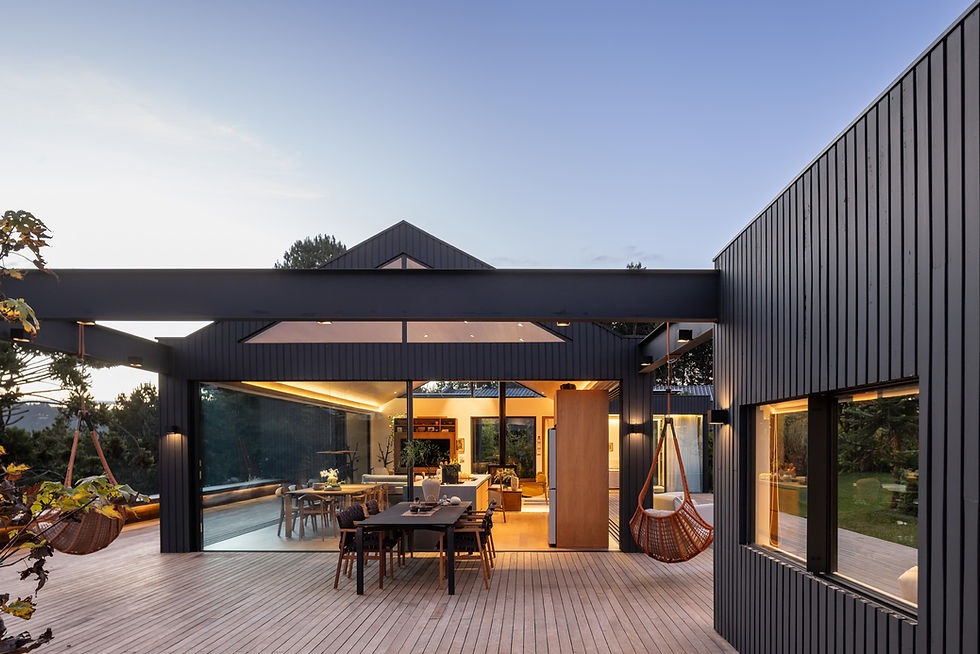
The floor plan was conceived in a U-shape, with slightly offset volumes to respond to functional and distribution needs. This strategy creates visual and spatial relationships between the blocks, connected by open courtyards and a slatted pergola that filters light and defines the transition between indoors and outdoors. At the center, an open courtyard frames the view of the valley. The main volume, with its gabled roof and large glazed openings, recalls the archetype of shelter, filtering light and framing the landscape. In the lateral wings, the suites receive abundant sunlight and cross-ventilation, reducing the need for mechanical cooling.
TIKIRA HOUSE


The structure combines a concrete foundation with a steel frame, allowing for generous spans and visual lightness. Enclosures blend masonry and timber, with certified natural wood cladding on the exterior. Flooring features solid wood in social and private areas, enhancing warmth and visual continuity, while large-format satin-finish porcelain tiles are reserved for wet areas such as bathrooms, laundry, and the ceramics studio, ensuring durability and easy maintenance.

Sustainable strategies guide the entire conception. Passive ventilation and lighting, solar-oriented placement, and the use of locally sourced materials reduce environmental impact. The roof supports photovoltaic panels for energy generation, water heating is powered by solar energy, and rainwater is collected for reuse. The house also features a graywater treatment system, further improving water efficiency. Preserving the vegetation and buildings on the existing plateau significantly reduced the construction footprint while strengthening the home's connection to its place.


Inside, fixed joinery designed by the studio organizes spaces and integrates functions. Furniture combines contemporary Brazilian design with artisanal pieces, creating a language of comfort, simplicity, and functionality.
A separate volume, immersed in the forest, houses the ceramics studio for the owner and her daughter, extending the creative experience in direct connection with nature.
More than a house, Casa Tikira is an architecture of presence. It translates the rhythm of the forest into form, light, and texture, offering a way of living that is intimate, simple, and deeply rooted in the land.


Project Information
• Project name: Casa Tikira
• Location: Campos do Jordão, São Paulo, Brazil
• Built area: 300 m²
• Site area: approximately 3,000 m²
• Completion year: 2025
• Architecture and interiors: Shinagawa Arquitetura
• Lead architect: Rogerio Shinagawa
• Project team: Hanna Akemi Castro, Rafael Nery
• Photography: Evelyn Muller
• Set design: Deborah Apsan
• Woodwork execution: Taniguchi
• Construction company: Fausi e Cezario Construtora
• Lighting design: Lumini

